28 October 2008

the great emergence

Phyllis Tickle, The Great Emergence (Grand Rapids: Baker Academic, 2008).

Much of what Tickle's book is can be summarized in her own statement capturing the sentiment of Anglican bishop, Mark Dyer: ". . . that the only way to understand what is currently happening to us as twenty-first-century Christians in North America is first to understand that about every five hundred years the Church feels compelled to hold a giant rummage sale" (16).  Indeed, this is a more accurate reflection that might initially be recognized and Tickle's rendering of church and history follow along such lines.

The book itself is rather accessible, though most laity and less-than-averagely-interested clergy will find parts of it difficult to follow.  This is a shame as much of this readership would otherwise be greatly interested in the material and could certainly benefit from understanding the current climate of the church a little bit better.  So I will have to hesitate on where to recommend this as a read, though initially I thought it would be a book for many in such a position.  Further, the overall structure of the book can become confusing to the reader, especially the large sweeps through history on a thematic level.  Such a presentation lends itself to a back-and-forth telling of selective history and sometimes loses the reader (I found at certain points if I wasn't paying close enough attention I was mixing up time periods).

These critiques aside, what one does find in the book is an interesting presentation of the changing Protestant climate in North America.  Further, the evaluation of the socio-religious climate is quite helpful in understanding the whys and whats of the *emerging* movement.  Much of the bread and butter of this book is found in Part 3, where Tickle works on how the movement is working now and where it is likely to head as it unfolds.  And while the rummage sale of the church does not render the previous forms of the faith useless, it does change up the in-house decorating of what this generation of believers look like.

Although the *great emergence* is a very uncertain and unsettling process for many, Tickle does well to remind the reader throughout that these movements are necessary and vital to the overall work of the church.  She asserts that this leads to a "more vital form of Christianity" (17), that it breaks down the encrusted dogmatism of the previous generation, and that it energizes the church and leads to the spread of the gospel.  And she backs these three assertions up with the great 500 year moments in the history of the church.

My primary caveat to a book like this is that it is quite difficult to understand and properly evaluate a movement which we are currently experiencing.  With *emergent* Christianity, it seems that everyone is jumping ahead quickly to assert the significance of their approach to the faith and to be the first and best to characterize the movement itself.  Although no book can critique the current landscape without hitting some of these snags, Tickle does a really good job at navigating away from such pitfalls (she comes close a few times, but that's my critique).  It would do the *emergent* crowd well to move forward with great humility before God (some do and others don't), and not get ahead of themselves on their own impact.

In the end, this is a good book with a good message, though not without its own faults.  How emergent of itself.

27 October 2008

church basement really awesome apocalyptic B movie festival (part two)

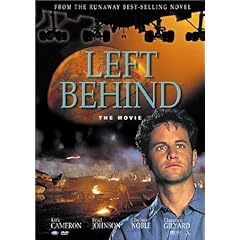
MOVIE TWO: Left Behind (2000)

This movie has one two awards, both documented in Jason Boyett's Pocket Guide to the Apocalypse (2005): 1) "Best Use of a Former Teen Heartthrob, and 2) Only Use of a Former Teen Heartthrob Named Kirk Cameron.  Way to go Cloud Ten Pictures!

SYNOPSIS:
(Seriously, if you don't know the basic plot of this one by now, what rock have you been under for the last ten years?!?)  OK, OK, OK, OK . . . Based on the 1995 runaway best seller endie series, Left Behind: The Movie chronicles the events of the rapture, and the events which follow.  Thus we see the world reaction to millions of people who have disappeared, the rise of the antichrist, the unravelling of a grand government conspiracy, and the seeds of a one-world religion.  Classic.  The rise of darkness inspires a band of those left-behind-who've-now-converted to join together so that they can ride out the next seven years (which are conveniently mapped out for them in Daniel, Revelation, some stolen blueprints, and a VHS of T. D. Jakes - which, in a surprising twist for him, actually uses Scripture!).

We see clearly that the rising antichrist is clearly evil and have some seeds that he is Satanic, though it is all a bit confusing at this point.  Following what is possibly the best men's restroom come-to-Jesus scene ever documented on film, we see how sinister this Nicolae really is - he rids his path to power from those who obstruct it and brainwash everyone who did not have an extended men's restroom come-to-Jesus scene.  But, according to a note in Boyett: "He gets named People magazine's 'Sexiest Man Alive,' though, so no one bats an eyelash" (155).

Enjoy the movie trailer:


ISSUES:
Many.  Too many to include.  Too many to count.
The beginning of the movie has a voiceover by Kirk Cameron as we are given a view of the world, in which the viewer is challenged with the question: what if the rapture is true and we didn't believe it?  A clear move by church basement apocalyptic B movies - the use of fear to inspire one's relationship with God.  We are seldom given any opportunity to consider what if there is not a rapture and the church is summoned to working through the tribulations of this world.  Some call it fire insurance theology, I call it stupid biblical interpretation.  Especially in light of the fact that many who accept a rapture theology have a very anemic view of the kingdom being made known into an increasingly hostile world.

And speaking of stupid biblical interpretation, the movie (and the book) is filled with misreadings of Scripture and hermeneutical fallacies that even Jim West wouldn't commit.  Specifically, the approach to the Bible which is little more than an end times manual for those who are left behind, as though it has no message to those who who are not living in the time following the supposed rapture.  I mean, God so frequently gives us revelation in order to hide important things from our lives and keep secret those things which will only affect a small sliver of humanity and history, right?  The cross-reading of Daniel and Revelation is also nauseating since the two are complete messages in and of themselves (AND, the term 'antichrist' doesn't even appear in Daniel or Revelation, let alone all the things that the antichrist is going to do in the post-raptured world!).

Finally, I think the guy who plays Nicolae sucks at it.  But that is pretty much just my own preference coming through.  I mean, what do I care about who plays a fictional character in some stupid movie that is so loosely tied to Revelation that I'm shocked they even mention the word 'Bible' in the film?  But I do care.  He could have been better.  I'm thinking Dolph Lundgren would have been perfect (you know, the Soviet boxer in Rocky IV).  Yeah, there's an antichrist we can all get behind.

22 October 2008

recovering pharisees 3: unengaged visible holiness

Amy-Jill Levine, "Luke's Pharisees" in Jacob Neusner and Bruce D. Chilton, eds., In Quest of the Historical Pharisees (Waco: Baylor University Press, 2007), 113-130.

Probably the most significant contribution which emerges from Levine's essay on the Pharisees in Luke-Acts is that she challenges many preconceptions which the reader brings to the text.  Sometimes her argument is more convincing than others but, on a whole, she does a solid job of this.  Whether or not she is able to reconstruct an accurate understanding of the sect is difficult to say - some will clearly think she has while others doubt her presentation.

From a literary (and theological) standpoint, Levine believes that Luke includes the Pharisees in his gospel in order to enhance Jesus' role in the narrative (115).  There is a sense in which I can accept this as true, but it doesn't account for the whole of their function (and she might not have even gone that route, given a more developed conversation on this point).  But the Pharisees are representative for Luke (and the other gospel narratives) of the primary ideology during Second Temple Judaism - a strong voice from within the common narrative of God's people in exile.  In this sense, she would be correct; but not if we see this enhancement as simple straw-manning for the sake of setting up Jesus.

Of special issue in the Gospel of Luke is that Jesus shares table fellowship with the Pharisees - which means that there must have been some level of acceptance into the Pharisaic community (cf. 120).  This is an interesting point, as it muddies the waters of separation which evangelicals have typically placed between Jesus and the Pharisees.  But the narrative suggests otherwise, that these were individuals who were concerned with the holiness of Israel but who too often did not follow through on their commitment to this end.

What is at stake, therefore, is Torah interpretation (cf. 122f.).  The focus lies on the approach to understanding Torah which has been taken by Jesus and the Pharisees - how do we take the Hebrew Scriptures and apply them to daily life?  This is connected (in Levine's article) to the parable of the Prodigal Son, where the primary issue becomes the willingness to seek out sinners: Jesus is willing to do so, the Pharisees are not (cf. 126).  We do see, however, a constant Pharisaic presence within the nation of Israel: they do not simply remove themselves from the ritual impurity of the population.  Rather, they maintain their visible presence in Israel even though they are not reaching out to the impurity around them.

If we are to maintain the thesis of this multi-part study which claims that the Pharisees are the closest equivalent to modern evangelicals, then we must consider whether or not our interpretation of Scripture is flawed.  I believe we find our clearest point of connection here within the visible presence of evangelical Christians, even when there is very little outreach happening.  To what end were the Pharisees interpreting?  It may be too difficult to make an historical conclusion on this.  But modern evangelicals are interpreting for their own sense of salvation and security, benefit and blessing.  This is how we have become Pharisaic in our contemporary culture.

20 October 2008

hearing jude

Last week sometime I posted about the infrequency of my posting, largely due to many of the activities which have me running.  And the fact of the matter is that I'm a bit fatigued on a few levels, though not ready to complain about any of it.  It is thus no surprise that things like last week's end choose to happen.

And as some frustrating situations arose, I was tempted to act out of my fatigue and recess into the background.  Then during a time of prayer my mind was drawn to Jude, "Dear friends, although I was very eager to write to you about the salvation we share, I felt compelled to write and urge you to contend for the faith that the Lord has once for all entrusted to us, his people.  For certain individuals whose condemnation was written about long ago have secretly slipped in among you.  They are ungodly people, who pervert the grace of our God into a license of immorality and deny Jesus Christ our only Sovereign and Lord" (3-4).

I will not comment on two of the situations, but will address the third.  I teach adjunct at the same college I attended for undergraduate (and have been closely tied to for many years).  I was informed last week that they will be offering yoga courses as part of the physical education department come spring.  This is a big let-down, and there is not much chance that I will be able to make a change to the situation (hence, my fatigue telling me it's not worth it).  But because I have spent numerous hours researching new religious movements such as New Age (along with Hinduism proper), I can not allow this to go unchallenged.

I am aware that some Christians believe that there is nothing wrong with yoga.  Yet I cite the constructive curmudgeon (and leading scholar in this field), Douglas Groothuis: "If it is really Christianity and it is really yoga, the two are incompatible because they represent two opposing worldviews."  Further, I do not believe that (given an accurate history of the practice of yoga) that it can be separated from its physical and spiritual attributes - the actual positioning found within yoga are designed within the realm of pantheistic monism; to bring one in proper alignment with the forces of the universe, allowing energies to flow through the body.

When sharing my concern with another faculty, he defended *Christianized yoga* as a real possibility and suggested that I was caught up in a mind-body dualism which didn't see the potential.  His running into a shabby tower made of philosophical terms did not sway me, for I assured him that it is because of my firm belief that everything is spiritual in the biblical mindset that practices such as yoga are dangerous to one's spiritual well-being.  And like Joe versus the volcano, he had no response to that.

So, because of the exhortation which is found in Jude (which I realize was not written with me and this specific situation in mind) I will delve into even more areas of engagement which I don't really have time for.  But I believe that the spiritual (and physical) well-being of many students is at stake, along with the spiritual climate of the campus.  Maybe nobody will listen, maybe somebody will.  It will be beyond my control.

Incidentally, here are a couple of good resources:

16 October 2008

the coming of the son of man

Andrew Perriman, The Coming of the Son of Man (Tyrone: Paternoster, 2005).

Here is a book which has been on my reading list since its release, but which only recently (finally!) made it onto my desk.  In fact, it was while attending LST's biblical studies conference in September 2008 that I was introduced to Andrew Perriman.  After interacting with his paper on eschatology in Romans and sitting next to him through dinner, I knew that this was a book to prioritize on the list - here is a world class biblical theologian who offers fresh air into the arena.  And, yes, this book lived up to my expectations greatly.

The greatest benefit from reading this book is that it seeks to establish biblical eschatology within the context of the original authors/hearers.

The greatest challenge from reading this book is that it seeks to establish biblical eschatology within the context of the original authors/hearers.

What I mean to say here is that it would be fairly easy, I suppose, to assume that Perriman's eschatological reading is bound to the experiences of the first century Jewish Christians and nothing more.  In fact, some of the passing critiques I have heard about this book is just that - that everything for Perriman is dependent upon his preterist reading.  After working through the book I would argue against such a reading as failing to grasp the overall thesis of the work, while at the same time be willing to concede that some of Perriman's conclusions are not as clear as one might hope for (leaving some of his argument open to the criticisms).

The primary thesis of the book is found in the belief that New Testament eschatology, which is rooted in Second Temple Judaism, which told an important story about the coming of the Messiah, must be read in its original context in order to be understood.  This is key to understanding Jesus as an historical figure, and the only way in which we can properly understand the perspective of ancient Israel, the gospel accounts, or the early church.  In fact, most biblical scholars (who aren't fundy kooks or left behind idiots) would most likely agree that any text in Scripture cannot mean for us today that which it could not mean for the original audience (although, it might be able to mean more).  If we agree with this, then we are off and running to understand Perriman's work.

Thus, the book moves through some of the Old Testament background - beginning specifically with the Daniel narrative - and then through Jesus' teaching and activity in the Gospels, and then through the rest of the New Testament.  I'll not belabor the chapter-by-chapter argument which he provides.  In reading the material found in the Gospels Perriman draws back the reigns of the many wild assertions which fill Jesus' words throughout the Olivet Discourse (et. al.) into a first-century Jewish-Christian context.  In other words, he blocks the reader from simply reading the end-times scenario here as something which applies only to Western Christians living in the 21st century and returns to a reading which understands that Jesus was addressing first century Jews living in Roman occupied Jerusalem while waiting for God's Messiah.

A more accurate reading of the New Testament is found here: "But we should not lose sight of the fact that salvation is the response of God to a particular set of circumstances" (227).  This is absolutely true.  In fact, the entire Jewish faith is built upon this concept (i.e., Passover, the exodus event, many psalms. . .).  Only when we understand the timely nature of the message can we understand the timelessness of its truth.  We cannot apply a message into a contemporary situation if we never understood it in its original context.

At the end of the day, this is a good reading of New Testament eschatology.  In fact, it does more justice to the biblical text than many other competing voices.  I do not leave it without some of my own questions and contentions of how he handles specific points here and there, but these amount to minor quibbles in view of the strong contribution which Perriman has made to the field of work here.  This is highly recommended.

13 October 2008

church basement really awesome apocalyptic B movie festival (part one)

Some of you know that one of my latest and greatest wishes is to host a movie festival.  Not some artsy fartsy reveling of modern cinematic achievement, but a celebration of some of the absolute worst witnessing (and theatrical disgraces) the church has ever been able to achieve.  Since funding is not available at this point - and blogging is free - then I will begin a cyber version of my quest.

Thus, I present a Church Basement Really Awesome Apocalyptic B Movie Festival.


MOVIE ONE: A Thief in the Night (1972)

This (really) is the original and classic film dedicated to wild apocalyptic imagination with little to no basis in actual Scripture, even though Scripture is referenced throughout.  It is, in a sense, the original Left Behind.  And, yes, it is still available for purchase to this day (and most likely still in use in various fundamentalist churches and camp meetings around the country).

The story centers around Patty, a young woman who considers herself a Christian because she basically doesn't do anything wrong and follows the Ten Commandments; she is considered 'practically a saint' by one of her girlfriends (but she turns out to be evil in the end, anyway).

One morning Patty wakes up to find that her husband is gone - a result of the rapture which is *clearly* taught about in Scripture.  Thus she realizes that she has been left behind to deal with a world which is slowly slipping into hell.  The worldwide leaders establish UNITE (United Nations Imperium for Total Emergency) to deal with the situation.  They eventually go around and mark everyone with a (miscoded) binary symbol of 666.

Unfortunately, UNITE only has one van.  So when they attempt to arrest Patty she is able to escape quite easily.  A very dramatic plot twist is when Patty takes their one van, much to the dismay of their two uniformed cops.  But it turns out that they have got themselves a helicopter and track down their stolen van and the driver.  It is never mentioned why she is such an important person to capture, seeing as how she is not able to interact with anyone else (for food, etc) without the mark of the beast.

The really thriller comes at the end.  This is a SPOILER, so don't read this paragraph if you plan on actually sitting through this piece of crap (. . . again).  Patty is on a bridge when she is about to get captured.  She falls of the side and plunges to her death.  Then, she awakens in her bed and realizes the entire movie had been a dream.  BUT! she then hears the radio reporting that millions of people have vanished and then comes to realize that her (believing) husband is gone as well. . .she has missed the rapture and has now been left behind.

Enjoy this musical number during the opening sequence:


Where to begin?  The storyline is full of holes and rarely makes much sense beyond a superficial level.  Scripture is used throughout, and a number of people confess Christ in the movie (and probably as a result of watching the movie).  But the interpretation of Scripture is misleading and hermeneutically anemic.  There is very little here which could commend to sound Christian orthodoxy, even if you think that a pre-trib rapture is possible.  Christians in the movie are not presented well, either - *true* believers are constantly portrayed as having nothing else to be concerned with than the imminent rapture and getting others to ride that J-train.  Never are any of the new believers directed to an outward working of the gospel - it is all about the personal decision and life change of the individual (I feel different, better).

The ending is ridiculously stupid, for it gives the impression that history is already set in the area of salvation.  That, while Patty is given this dream as a warning of the choices in her life, she is never given an opportunity to repent and believe.  As Dickens wrote from the words of Scrooge, "Why show me this if I am beyond all hope?"  Indeed.

Things I've learned:
1. I really don't like Larry Norman songs, except for this version (yeah, that's a joke).
2. People in white vans are probably trying to abduct you.
3. Friends who are preoccupied with sex will most likely end up dating the antichrist.
4. Sincere Christians who don't preach the rapture will be screwed and left behind.
5. UN military officials probably left the keys in their van.

07 October 2008

blocked and diverted

A lagging in some posting has occurred, and there is no sudden burst of inspiration on the immediate horizon (but do we ever really sense it coming on?).

Right now my flurry of activities is having its way with my schedule and I am spending much of my time just keeping up.  This happens from time to time and I've learned to go with it instead of fighting it.  Of particular frustration is my own doctoral research.  Right now I'm on the middle of my MPhil year, looking to propose and move forward with the PhD as soon as I can square away my original topic.  At present I have the overwhelming feeling that every good and worthwhile idea which I come up with has already been done or is something which I don't really believe to be true in the first place (and would not convince anyone of anything).  So I'm returning to previous works and going through, going through, going through them again and again until the path becomes visible again.

This is frustrating because I have already felt some setbacks in the working out of my programme, and fear of not being ready to move to the next step when the appropriate time comes.  So, I suppose now would be a good time to figure out if I'm actually a scholar or just someone who has hacked into the system.  Time will tell and the blogging will be sparse, but it's the children (and Tilling) who suffer.

02 October 2008

the blue parakeet

Scot McKnight, The Blue Parakeet: Rethinking How You Read the Bible (Grand Rapids: Zondervan, forthcoming).

Much thanks to Scot McKnight for his advance reader copy of his latest book.

The main objective of The Blue Parakeet is to answer the question(s) of reading the Bible in a manner which is both faithful to the biblical text while being meaningful to the modern world.  McKnight illustrates this in his opening chapter by raising some questions of how to read various parts of Scripture, highlighting the fact that Christians have long taken certain portions of the Bible to faithful practice while ignoring other parts (sometimes side-by-side passages!).  This is a situation which is prevalent in the church and seeks an answer.  McKnight has made a solid step forward in this discussion.

The book is well-written, being both accessible to a wide variety of readers while also reflecting a solid base of academic rigor and scholarship.  One can easily tell that McKnight has spent much time interacting with undergraduate students, as he is constantly mindful of showing relevance to the theoretical by including various illustrations to help in the learning process.  The book itself is divided into four parts, three of which carry the weight of the book's main idea: that the Bible can be accessible and living for us, if we can teach ourselves how to read it.

Section One: Story
The primary quest of this section is to find an approach which will ". . .turn the two-dimensional words on paper into a three dimensional encounter with God. . ." (41).  McKnight thus explores the notion that Scripture contains a story, beginning with his view of various "shortcuts" to a full and proper reading of the text.  Against these approaches he suggests a reading which will encompass the biblical perspective, and embrace the story which is on these pages.  This requires a reading which allows the story to emerge within each writer's own perspective - allowing Paul to be Paul, Peter to be Peter, and Jesus to be Jesus for example.  In explaining this McKnight uses the notion of a "wiki-story" (63ff.), the notion that while different authors and stories exist (and give their own version of the bigger story), they are held together by the larger narrative.  These are the blue parakeets which are loose in the biblical text.

Section Two: Listening
In setting forth an answer to how one should read the Bible, McKnight proposes a relational approach - that through these pages we are summoned to a relationship with God.  There is an authority in the text, but one which works through the relationship of reader/church, the text itself, and God.  The question thus becomes, "What is our relationship to the God who speaks to us in the Bible?" (which is specifically addressed in Chapter 7).  Such approach demands that we learn to listen in order to grasp what the story holds.  McKnight offers an approach to "missional listening" in Chapter 8.  This idea is simply that the story in the Bible is intended to make an impact into the world - we must listen within the context of being missional.

Section Three: Discerning
The final section navigates the difficult task of figuring out which of the biblical commands and ideals are to be kept, and which ones we are allowed to ignore (at least, practically speaking).  After demonstrating that this is a more difficult endeavor than might be initially realized, McKnight suggests finding the "pattern of discernment" which is visible in the tradition of the church and is available through the work of the Spirit.  By understanding some of the 'wiki-stories' which are in Scripture, we might find our way of living out our (wiki-)faith into our world.  The latter half of Chapter 10 includes six areas where such decisions have been made, and continue to be raised.

Section Four: Women in Church Ministries Today
At first glance, I disappointingly expected this section to be disjointed appendix to an otherwise interesting book.  Evidently I did not immediately see this issue as a simple hermeneutical-method problem.  And, having labored through my share of texts on the debate, I hope that I will not be faulted for being less than enthusiastic about the topic.

However, I must say that these final five chapters are of the most well-written, thoughtful, and biblical perspectives I have encountered regarding the debate over women in church ministry.  McKnight approaches the topic clearly and straightforwardly, but does not lose sight of the reality of either the mission of the church or the real-life impact of women engaged in ministry.

Overall, McKnight comes out as a proponent of women working alongside men in the church (under, over, all that good stuff).  There is a strong commitment in this book to hear the whole of Scripture and not only those parts which are deemed 'pertinent' to the debate.  This is likened here with that of teaching on marriage by looking only at those few passages which speak about divorce.  When we discuss the role of women in ministry we must be, McKnight contends, willing to hear the whole of the story.  And there is abundantly more positive than negative when viewing the entirety.

It would be interesting to consider how using this book in an introduction to biblical interpretation course would go.  So much of the material is good and necessary for the church (especially young interpreters) to hear and understand, although McKnight does not go in and out of various types and styles of the literature employed.  Rather, he is content to see the story as a whole and to watch it move through its various incarnations within the text - and into the world today.  This one comes highly recommended.

01 October 2008

λαὸς εἰς περιποίησιν


While working on a passage in 1 Peter this past weekend I was struck by a concept which I've not previously encountered (which by no means makes it novel or right).  But I remember translating the letter in one of my final semesters of graduate school and not catching this, so it might be one of the rarer ideas, and thus in danger of being completely wrong.  But, nevertheless, I proceed.

An interesting passage is 1 Peter 2:9-17.  In his letter as a whole, the apostle uses Christian and Jewish conceptions and terminology interchangeably - which makes for a really fascinating study.  In 2:9 this includes a listing of functions and titles for this community.  They are a chosen people, a royal priesthood, a holy nation, a people in possession.  These phrases are Jewish by nature but are now being applied to the church, as a fulfillment of the gospel.  Peter appears to be drawing from Exodus 19:6 and Isaiah 43:20-21 to bring together these ideas.  The function of Israel is now redefined within the concept of the church, with much continuity throughout.

What strikes me as of particular significance here is the phrase λαὸς εἰς περιποίησιν (what I've translated as "a people in possession").  Most translators here refer to this as God's possession or God's special possession or even a people of God's special possession.  But the reference to God is not present in the immediate context; it must be supplied by the translator.  Although the context can certainly support this type of reading, the actual text reads simple "a people in possession."

In its Old Testament context, the idea of a people who are in possession most directly refers to the nation of Israel coming into possession of the land (cf. Deut 2:9-13; Josh 1:10-11; Obad 17-21; et al).  The people in possession have arrived at the realization of God's presence, the fulfillment of the covenant promise to inherit the land.  Such phrasing and verbal allusions abound in the Old Testament as a way of referring to the fulfillment of the covenant promise, and I believe Peter to be referring to the same idea here.

This means that Peter is not necessarily concerned with the church being known as God's special possession, at least not in these particular three words.  He is preoccupied with the notion that the covenant has been fulfilled and the eschatological community has been realized.  The church is the true Israel: the chosen people, the royal priesthood, the holy nation, the people in possession (all terms of the covenant promise of Israel).  

Now, I'm willing to concede that I'm missing something in the Greek phrasing with the specific translation if there is a clear reason to translate it the other way.  But the language alone doesn't seem to do it for me and the context seems to support my idea.  And if there is a reason to read it as "God's special possession" this would not necessarily contradict the covenant motif.  It would change the force of the statement perhaps, but not that much.  The possession of God is also seen to be no longer bound to a geographical locale but of those people who are from every tribe, tongue, nation and creed.  

In the end, though, Peter seems to be riding the train of covenant fulfillment in the community of the church.  And this would mean that Peter interprets the people in possession to be those who participate in the eschatological community of salvation (the church) who have inherited the covenant blessing of land, now redefined as all people who participate in the kingdom who have inherited all of creation in the fulfillment of that covenant.

I'd be interested in your thoughts. . .