 You may find my review of The Bishop's book on justification now posted at the Denver Journal.
30 April 2009
review of NTW justification
You may find my review of The Bishop's book on justification now posted at the Denver Journal.
magic acts
I don't think anything competes with a magic act for humiliating entertainment value.
What is the point of the magician? He comes on, he fools you, you feel stupid, show's over. You never know what's actually happened. It's never explained. And that's the kind of attitude the magician seems to have as he's performing.
It's like, "Here's a quarter. Now it's gone. You're a jerk." Sometimes they ask you to blow on it. There's something mature adults like to do, blow on a deck of cards. I also love that little pretend look of surprise they do when the trick works. Like, "Oh, I didn't know that was going to happen myself. I even amaze me."
~ Jerry Seinfeld
[N.B., In the end I do believe that one could insert a variety of 'hermeneutic' for 'magician' and 'text' for 'quarter' - as for the blow, that's up to you to decide . . .]
21 April 2009
frogless biology, bibleless theology
 OK, time for a brief rant. Every Tuesday and Thursday morning I lecture an introductory biblical studies course which covers everything from Genesis to Revelation. At the beginning of the semester I stated the importance (actually, the need) to bring one's Bible when attending a Bible class. I am intentionally over-the-top on this so as to be effective and memorable. Yet, it never fails that after a couple of weeks this habit falls by the wayside. So I continue to mention it throughout the semester.
But today met the boiling point.
This morning we were due to introduce Paul (we'll cover Paul the whole of this week), and when turning to Galatians I discovered that roughly one-half of my students did not have a text in front of them! I pointed this out, explaining to them that if they could not follow Paul's argument along with me that they probably won't be able to keep up - it is often hard enough when one is in fact reading it.
After my short quip about this condition it dawned on me that this is like sitting in a biology lab without a frog - nobody would consider this an acceptable method of conducting a lab. Yet this is how much of evangelicalism is conducting theology (in step here with Tom Wright's critique of Pauline methodology), sitting around to construct ideas which already sound good to us but which have no real basis in the text. There you have it - frogless biology and bibleless theology.
20 April 2009
new perspective and openness: strange bedfellows?
 Today I received my copy of Tom Wright's response to John Piper's critique on the Pauline view of justification. This is the very highly anticipated next-step in the ongoing debate of the topic, and proves to provide another (albeit more pointed) summary of Wright's exegesis and overall theology. Admittedly, since IVP is taking its time to release the US copy of this I took it upon myself to order the UK version (SPCK) so that I could get on with it. And I plan on reviewing it in more detail as the week goes on.
But for now I must offer a rather simple observation that I've made regarding the nature of Piper's criticism of Wright. [N.B., I happen to believe that Wright has it more correct than not, and that there are serious flaws in Piper's thinking and hermeneutic, both here and elsewhere.] In the introductory chapters the reader is brought up to speed regarding the nature of the debate, why it matters, and what is and is not being said by Wright. The book itself is a direct reply to Piper, though other critiques of the 'new perspective' find their way into the discussion. One of the issues which bothers Wright a great deal is Piper's insistence that we appeal to the writings of the Reformers, to which Wright believes happens at the expense of reading Scripture in its original context. Indeed, Piper seems to be willing to ignore first-century Jewish thought altogether for the sake of systematic development! Yet, Wright says it well: "The greatest honour we can pay the Reformers is not to treat them as infallible - they would be horrified at that - but to do as they did" (6).
It was at this point of the book that something struck me as particularly interesting: there are significant similarities between the 'neo-Reformed' (if that is an adequate term to describe this crowd, I stole it from Scot McKnight on the back of the book) in their critique of the new perspective as there is on their attacks of Open Theism. Seriously. Having known two of the more prominent Openness figures over the past ten years, I have seen firsthand how such 'critiques' can get out-of-hand and vicious, rather than constructive and kingdom-building. And the same moves which have been present in this debate, by the same opponents, using the same publishers, are being recycled here to protect their own take on tradition over anything else.
Taking the response to Sanders' The God Who Risks as an example . . . In this book, John Sanders seeks to give a biblical theology (which is a category often unrecognized or misunderstood by the 'neo-Reformers'), by placing texts in their original contexts which help to construct a faithful doctrine of God. There are some places where he is right; other places where he is wrong. But he does a solid job of navigating through the material, especially since he's been echoed by well recognized biblical scholars who are trying to accomplish the same thing (T. Fretheim, J. Goldingay). But some of the earliest (and ongoing) criticisms of him directly is that he is flying in the face of the Reformation tradition which has already told us what the doctrine of God is supposed to be.
Those of you who are keeping up with Piper-Wright should recognize this. For Piper and Ware are two of the most outspoken voices for the notion that the Reformation tradition is the trump card against Open Theism, instead of working within the realm of the biblical text. The result is the familiar ". . . debate, the 'arm-wrestling', the 'text-trading', the endless footnotes, the massive scholastic tradition of mutual references, refutations, restatements, and so on" (Wright, 66). Perhaps I'm confused, but what has happened to sola Scriptura?
When this is all boiled down, it should provide a significant blow to the academic credibility of this crowd - especially with the recycling of the rehashed arguments. I do not doubt for a moment that their hearts are sincere (though many of this camp have said otherwise about their opponents). But my grandmother's heart is sincere and she has no business offering a scholarly critique of Open Theism or NPP either. If we broaden our view and see what is happening here, we might just be at a turning point in the way we conduct our rhetoric - at least, in terms of those whom we will take seriously and those we won't.
16 April 2009
reclaiming revelation
 Well, it's happened again. Another conversation led down the path of discussing Revelation and the inability for people today to adequately understand it. Over the past few years I have had a handful of people express their frustration (and surrendering) of attempting to make any sense of the book, including two pastors (one with a DMin) and now an academic (with seminary training). This is certainly getting out of control - our unwillingness to make heads or tails of the end of the Bible is leaving the door wide open to the kooks and the nuts and their ability to hijack the Christian faith and present nothing more than shallow fantasies which run counter to the biblical message.
What is happening here?!?!
A few years ago I was given the opportunity to teach an undergraduate course for non-Bible majors which centered on any topic or book of my choosing. After some thought I chose Revelation, partly because I thought it would be an eye-catcher for such students. It was. But it was also an opportunity to help direct others through the same journey I had once experienced - that Revelation is not relegated to the freaks and the kooks who want nothing more than the immediate and decisive destruction of the earth, preluded by events which are foretold in our Bibles and played out in our headlines. Rather, Revelation is the culmination and synthesis of the biblical story of hope and resurrection, covenant and life, renewal and restoration. It is, without qualification, one of the greatest literary pieces ever put down by human hand.
Of course, many of us have only experienced the Sunday School experts who can command small group discussions regarding long-and-drawn-out words and biblical-sounding concepts, but who cannot work their way out of a philosophical wet paper sack in any other situation. They have for years told many of us that Revelation is God's predicting of modern events and can foresee the end-times with the certainty of a Hal Lindsay pocket calculator. This was a large part of my experience growing up, until I was able to read R. Bauckham, The Theology of the Book of Revelation (Cambridge: CUP, 1993) and hear my graduate mentor, Craig Blomberg explain how to properly approach the book. (The premise: you have to know how to read it.)
And therein lies the problem. The book of Revelation needs to be read as an apocalyptic work which stands on its own before it can speak beyond the borders of its own text. Further, it must be read in light of its own historical circumstances prior to pushing our headlines into its space. This is basic hermeneutic . . . so, then, why are so many church leaders running from it?
First, it is a charged situation - emotions run high. And when you deal with emotions you cannot use reason, so there will always be a segment of the population which have emotionally grabbed hold to Left Behind-ism and will never consider another option. Thus, it is perceived by many in the church and academy as a losing enterprise. Second, it is hard - there is a lot of legwork involved in understanding a socio-political and spiritual message from first century Asia minor when you are standing in 21st century America. Work and time are entities which immediately push something away in our world. Third, the genre scares the beJesus out of us - we have no idea what to do with apocalyptic themes from the Jewish world, so we try to make them apocalyptic themes from our world and then become frustrated when they don't inspire us.
This third point really is the main focus here - we have let the hijacking of this text and the constant misrepresentation of Revelation's message (along with the fact that it is 'hard' to understand [I actually don't accept the premise that it is hard]) to scare the beJesus out of us when it should, in fact, be pushing the beHell out of us!
Frankly, I do not care if Revelation is a frightening enterprise! It does not matter! Because we are called (all of us, not just the pastors and the academics) to be responsible stewards of the Word, proclaiming the full message of faith into the world. Is it coincidence that the final warning in Revelation (and the Bible) is fittingly: "I warn everyone who hears the words of the prophecy of this scroll: If any one of you adds anything to them, God will add to you the plagues described in this scroll. And if any one of you takes words away from this scroll of prophecy, God will take away from you your share in the tree of life and in the Holy City, which are described in this scroll" (22:18-19).
We will fail in the work of the kingdom by our silence and ineptitude. It is as simple as that. This rant is the boiling over of a lack of conviction regarding the whole Word of God - much of which is directly and immediately relevant to the current state of the world. And I further believe that God can still work through our fumbling and bumbling of what we think we know, but cannot do anything through our silence. I hope and pray for this to change.


08 April 2009

07 April 2009
a case for historic premillennialism
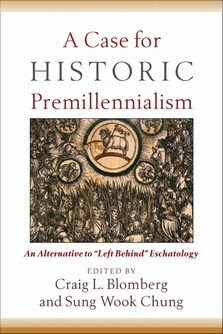 Craig L. Blomberg and Sung Wook Chung, ed., A Case for Historic Premillennialism (Grand Rapids: Baker Academic, 2009).
Although the fervor of 'Left Behind' theology has certainly died down from what it was just five years ago, the damage of its pattern of thought (unfortunately) has not. Thus, it remains the task of the academic community to continue in its response and education. The fact of the matter is that the perspective given in LB is so often out-of-step with traditional orthodoxy (at best) and is sometimes outright anti-Christian (at worst). If we truly believe that eschatology holds the power to shape how we live in the present, then it should not need stating that this level of theology matters greatly.
So it is good to see that the work goes on, even after the headlines aren't so frequent in our culture. As someone who has taught a course on Revelation for the last 4 years I can certainly testify that there is too much LB and not enough Bible-in context happening with our view of Christianity and eschatological thought. Knowing one of the editors and a few of the authors, I was willing to recommend this book sight unseen - but since I've read it . . . I will include my brief thoughts.
Chapter One: Dispensational and Historic Premillennialism as Popular Millennialist Movements (Timothy P. Weber) - the opening chapter presents a concise and solid historical overview of two millennial movements, tracing their developments while offering a critique of their thought. Personally, this chapter is beneficial for the many times I have been met with questions of how one perspective has become culturally dominant if it is not the more biblical model. There are certainly socio-historical factors at work in the solidification of Dispensational thought, and Weber provides a fair treatment of the record.
Chapter Two: The Future Written in the Past: The Old Testament and the Millennium (Richard S. Hess) - typically speaking, the Old Testament is ignored in LB eschatology except where it serves to directly advance their reading of Revelation (i.e., the flagrant and frequent misreadings of Daniel and Ezekiel). Hess seeks to put these particular misreadings back into context while also giving a fuller picture of OT eschatology. He rightly states: "These prophets were concerned with the future. They saw it as a time of restoration" (29). Quite right.
Chapter Three: Judaism and the World to Come (Hélène Dallaire) - this particular chapter widens the scope of the OT perspective by exploring the concept of afterlife and the resurrection of the dead. Admittedly, there is not much explicit evidence to explore on this topic in Torah and Prophets, but the author here does trace the development of thought until: "The belief that the soul survived death and that the body would one day be resurrected and reunited with the soul became the traditional Jewish view during this period and for many subsequent centuries" (55).
Chapter Four: The Posttribulationism of the New Testament: Leaving 'Left Behind' Behind (Craig L. Blomberg) - in what I would consider the most impacting chapter in the book comes in this essay which deals not only with the NT text, but also with the many misreadings and misuses of the data to serve other agendas (cf. Hal Lindsay; LaHaye & Jenkins). Since the NT contains the majority of texts used for constructing modern millennialism, this is perhaps the chapter which will get many people looking forward to most (if not just skipping to it first). In his typical fashion, Blomberg gives a solid survey of the landscape and interacts with modern questions and debate. Though there is too much here to give in great detail, of interest is his assertion that while the NT does speak of an imminent return of Christ, there is no 'hyper-immincence' of the parousia to be found (cf. 84).
Chapter Five: The Theological Method of Premillennialism (Don J. Payne) - having established a biblical reading of texts to support historic premillennialism, the book next examines its own theological approach. Attention is here given to hermeneutical principle, the role of tradition, reason, and experience (long live the quadrilateral!).
Chapter Six: Contemporary Millennial/Tribulational Debates (Donald Fairbairn) - the often forgotten perspective in much modern biblical and theological debate is that of church history. In this chapter, Fairbairn asks what perspective the early church had on the millennial issue. Of course, one would expect a survey which emphasizes the position of historic premillennialism . . . but the author is able to do so while also examining dispensational readings as well. One issue at the forefront is the challenge to 'literal' readings (from dispensational thought), which would have been methodologically foreign to the early church (cf. 119).
Chapter Seven: Toward the Reformed and Covenantal Theology of Premillennialism: A Proposal (Sung Wook Chung) - bringing together all of the material presented in the various essays, Chung offers a synthesis of thought and a proposal to move forward. Placing the argument as it stands explicitly against the Reformed tradition of amillennialism, Chung re-presents a theological reading of the covenant, citing texts and important moments in the covenantal history of Israel. Though I find some points of disagreement in Chung's overview of the covenant concept in Israel, his direction seems to be headed in the right direction - that the renewal of this world is in scope for the remaking of the heavens and the earth. And even though I accept his direction, there are still questions left unanswered in what he presents regarding timing and the role of believers in the process. But it is a good discussion-starter nonetheless.
Chapter Eight: Premillennial Tensions and Holistic Missiology: Latin American Evangelicalism (Oscar A. Campos) - this chapter has the feel of an addendum to the main body of the book, but does provide a wider perspective on millennial matters by opening the scope of the topic to a culture outside of American evangelicalism. A brief history of dispensational influence turns to modern mission within the framework of Latin evangelicalism help the reader to consider modern implications of the preceding material.
06 April 2009


Subscribe to:
Posts (Atom)